
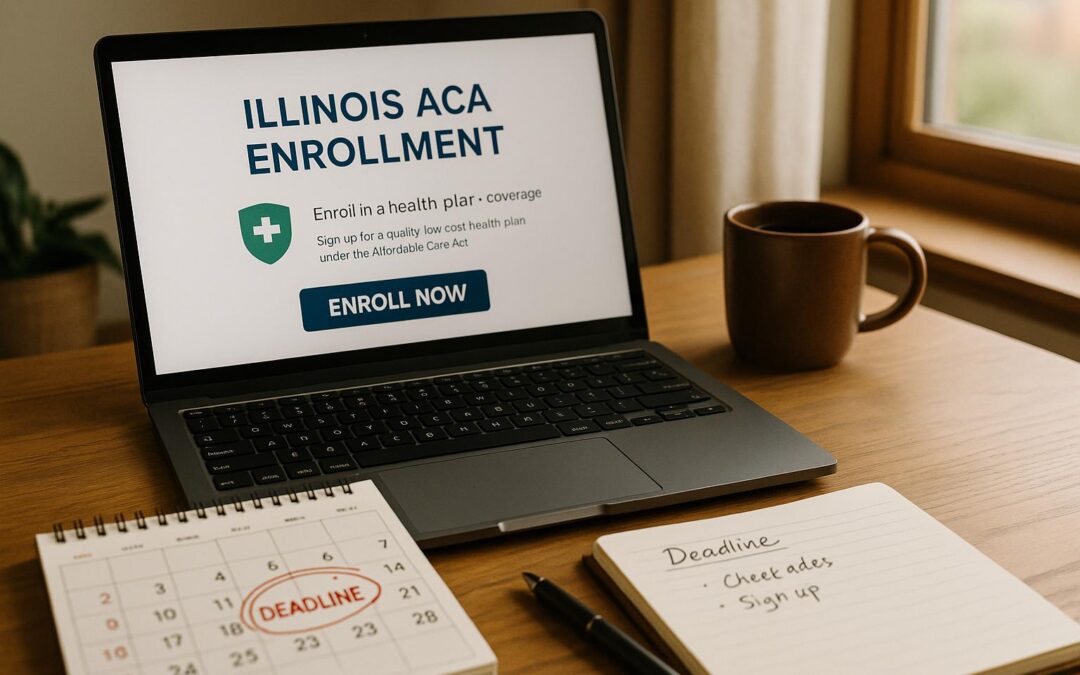
If you live in Illinois and need health insurance through the Affordable Care Act (ACA), here’s what you need to know:
- Open Enrollment Period: Runs from November 1, 2025, to January 15, 2026. This is your chance to apply, renew, or change your health plan for the next year.
- Key Changes: Starting January 2025, short-term health plans will no longer be offered in Illinois. Additionally, Illinois will transition to a State-Based Marketplace for ACA plans in 2026.
- Special Enrollment Periods (SEPs): If you miss open enrollment, you’ll need a qualifying life event (e.g., marriage, job loss, relocation) to enroll. SEPs typically allow 60 days to apply after the event.
- Coverage Start Dates: Apply early during open enrollment to avoid delays in coverage for 2026.
- How to Prepare: Gather documents like proof of identity, income, and household details. Estimate your income carefully to qualify for subsidies and avoid tax surprises.
For personalized help, Illinois Health Agents can assist with ACA enrollment, ensuring you find the right plan for your needs. Don’t wait – mark your calendar and get started.
Key Open Enrollment Dates for Illinois
2025-2026 Open Enrollment Period
In Illinois, the open enrollment period for ACA plans will run from November 1, 2025, to January 15, 2026. This is the time to enroll, renew, or make changes to your ACA coverage. Like most states, Illinois follows the federal timeline. If you miss the January 15 deadline, you’ll need to qualify for a special enrollment period to make changes. It’s also worth keeping an eye on upcoming changes to the state’s marketplace, as these could affect how you enroll.
Transition to State-Based Marketplace
Illinois residents should be aware of an important shift in how they’ll access ACA coverage. Starting with the 2026 plan year, Illinois will transition to a State-Based Marketplace. However, for the 2025-2026 enrollment period, applicants should continue using Healthcare.gov to apply for ACA plans. The state-run platform, launching in the following cycle, aims to provide resources and support tailored specifically to Illinois residents. This change underscores the importance of staying informed and enrolling within the designated timeframe.
Coverage Start Dates
When you enroll during open enrollment, the timing of your application directly impacts when your coverage begins. Enrolling early ensures your coverage starts sooner, while waiting until later in the period could delay your start date. Carefully review your plan details to avoid any potential gaps in coverage.
Looking ahead, the federal government plans to shorten the open enrollment period in most states starting in the fall of 2026, with the deadline moving to December 15. For the 2025-2026 enrollment cycle, though, Illinois will stick with the current schedule of November 1 to January 15.
Special Enrollment Periods: Events and Timelines
What Are Special Enrollment Periods?
Special Enrollment Periods (SEPs) allow individuals to enroll in or change health plans outside of the standard open enrollment period – provided a qualifying event occurs. Without a qualifying event, you’ll need to wait until the open enrollment period in November. The only exceptions are if you qualify for Medicaid or the Children’s Health Insurance Program (CHIP), which offer enrollment year-round. Until the marketplace transition is complete, SEPs are managed through Healthcare.gov. Below, we’ll dive into which life events qualify and the documentation you’ll need to secure coverage.
Qualifying Life Events
Not every life change qualifies for a Special Enrollment Period. The federal government has specific criteria to determine eligibility. Common triggers for an SEP include losing job-based coverage, changes in household size, or relocating to a new area. For instance:
- Marriage: This could allow access to a spouse’s employer plan or let you combine coverage for your household.
- Birth or Adoption: Adding a new dependent often requires immediate adjustments to your coverage.
- Relocation: Moving might mean your current plan no longer includes providers in your new area.
- Loss of Job-Based Coverage: This is often an urgent reason to seek new coverage.
Keep in mind, voluntary changes – like wanting a different plan – don’t qualify for an SEP. Once you experience a qualifying event, it’s essential to act quickly, as deadlines are strict. Let’s break down the timelines and documentation requirements.
SEP Deadlines and Required Documents
The majority of SEPs require you to enroll within 60 days of the qualifying event. This 60-day window starts on the date of the event itself – not when you decide to take action. Federal guidelines now require detailed documentation to confirm your eligibility.
| Qualifying Event | SEP Window | Required Documents |
|---|---|---|
| Marriage | 60 days | Marriage certificate |
| Birth/Adoption | 60 days | Birth certificate, court documents |
| Loss of Health Coverage | 60 days | Termination letter, COBRA notice |
| Move to New Area | 60 days | Lease, utility bill, driver’s license |
| Change in Income/Household | 60 days | Tax documents, proof of residence |
While most SEPs follow the 60-day rule, some events may have different timelines. Always double-check with official sources to confirm deadlines.
It’s crucial to gather the necessary documents without delay. For example, a marriage certificate will confirm marital changes, while a birth certificate or court adoption papers are needed for adding a child. If you’ve lost job-based coverage, be ready to provide a termination letter or COBRA notice. Relocating? Proof of your new address, such as a lease or updated driver’s license, will be required. For changes in income or household composition, tax records or other proof of residence may be necessary.
To avoid any lapses in coverage, consult reliable sources like Healthcare.gov or Get Covered Illinois. These platforms provide up-to-date rules and requirements, ensuring you stay informed as policies evolve. Proper preparation is key to maintaining uninterrupted health insurance.
Enroll In An Affordable Care Act Marketplace Plan
sbb-itb-a729c26
How to Prepare for ACA Enrollment in Illinois
Getting ready for ACA enrollment in Illinois means organizing your paperwork and understanding the steps to find the right health coverage. Preparation is key to making the process smooth and ensuring you get the plan that fits your needs.
Gather Required Documents
Having all the necessary documents on hand can save you time and prevent delays in securing coverage. Here’s what you’ll need:
- Proof of identity: Bring a driver’s license, state ID, or passport for each person applying. Include Social Security cards to confirm identity and eligibility.
- Income documentation: Collect your most recent tax return, recent pay stubs, and proof of any other income sources. Self-employed? You’ll need business records and profit-and-loss statements. If you receive unemployment benefits, Social Security, or investment income, have those statements ready as well.
- Tax information: Your previous year’s tax return is essential for estimating income. If you filed jointly, make sure to have the full return, including all schedules and forms.
- Household information: Gather Social Security numbers and birth dates for everyone in your household who needs coverage. If you’re married, you might also need your marriage certificate. Families with children should have birth certificates available.
Keep these documents together so they’re easy to access during enrollment.
Calculate Household Income
Your household income plays a big role in determining eligibility for premium tax credits and cost-sharing reductions. It’s important to provide an accurate estimate of what you expect to earn during the upcoming coverage year – not just what you earned last year.
Start by reviewing your most recent tax return. Add up all taxable income for everyone in your household, including wages, self-employment income, unemployment benefits, Social Security, and investment income. Then, adjust your estimate to include any expected changes, like a new job, reduced hours, or other shifts in income.
Experts advise projecting household income carefully and reporting changes – such as a job loss or promotion – throughout the year to avoid surprises at tax time. Using tax documents and pay stubs can help ensure your estimate is as accurate as possible.
For self-employed individuals, calculating income requires additional steps. Use your Schedule C from your tax return to determine net earnings after business deductions. Adjust for any anticipated changes in your business income for the year. If your income fluctuates significantly, it’s safer to overestimate slightly. This way, you minimize the risk of owing money at tax time and might even receive a refund.
Accurate income estimates not only help you qualify for the right subsidies but also prevent repayment issues when you file your taxes.
Compare Plan Options
Once your documents are ready and your income is calculated, it’s time to evaluate plan options. Illinois residents can choose from multiple insurance carriers, and while monthly premiums are consistent across different purchasing platforms – whether through Healthcare.gov, an independent agent, or directly from an insurer – the benefits and structure of plans can vary greatly.
When comparing plans, pay attention to these key features:
- Monthly premiums: The fixed cost you pay each month.
- Deductibles: The amount you’ll pay out-of-pocket before coverage kicks in.
- Provider networks: Make sure your preferred doctors and specialists are included.
- Prescription drug coverage: Check for specific medications and copay details.
- Copayments and coinsurance: Understand your out-of-pocket costs for visits and services.
"While most insurance products are similar in price and function, insurance providers are very different when it comes to structuring a policy that actually covers you." – Illinois Health Agents
Consider your family’s unique health needs when choosing a plan. For example, families with young children might prioritize plans with strong pediatric coverage and low copayments for routine visits. If you or a family member has a chronic condition, look for plans that include your specialists in-network and offer reasonable prescription drug coverage.
Professional guidance can make selecting a plan easier. Agencies like Illinois Health Agents work with top-rated insurance companies (A.M. Best Rating of A‑ or better) to provide quality options. Their agents focus on finding plans tailored to your needs, without being tied to any specific insurer.
"Every client is different, and we believe your insurance should be too." – Illinois Health Agents
The effort you put into preparing now – organizing your documents, estimating your income, and comparing plans – can make a big difference in your coverage experience for the year. Up next, learn about personalized support options to simplify ACA enrollment in Illinois.
Illinois Health Agents: Local Support for ACA Enrollment
Navigating ACA enrollment becomes much easier with the right local support. As Illinois prepares to transition to a state-based marketplace in 2026 and tightens regulations around brokers, having access to knowledgeable, local assistance is more important than ever. Illinois Health Agents provides tailored guidance to help individuals and businesses find coverage that fits their needs, while also steering clear of common enrollment pitfalls. Their expertise ties directly into the steps for successful ACA enrollment discussed earlier.
Personalized Assistance for Illinois Residents
Since 2007, Illinois Health Agents has been helping residents and businesses secure insurance, assisting over 15,000 individuals and businesses in Illinois annually. Their licensed agents simplify ACA enrollment by offering step-by-step guidance. As independent agents, they are not tied to any specific insurance provider, which means their sole priority is finding the best plan for each client. This independence is especially valuable in light of recent federal actions aimed at curbing fraud, where some brokers have enrolled or switched clients’ plans without their consent.
Comprehensive Insurance Options
For those worried about missing the standard enrollment window, Illinois Health Agents can help identify qualifying life events that allow for Special Enrollment Periods and ensure all necessary documentation is submitted on time.
In addition to ACA enrollment, Illinois Health Agents offers a wide range of insurance solutions, making them a go-to resource for diverse coverage needs. Their services include:
- Group health insurance for businesses
- Short-term health insurance for temporary coverage
- Vision and dental insurance
- Life insurance
- Medicare plans and supplements
For instance, a person might start with an ACA plan, switch to group coverage after launching a business, and later seek Medicare advice when nearing retirement. Their partnerships are exclusive to insurance carriers with an A.M. Best Rating of A- or better, ensuring clients have access to financially reliable and top-rated providers.
Why Choose Illinois Health Agents?
There are clear benefits to working with Illinois Health Agents instead of navigating ACA enrollment alone. Their deep understanding of Illinois’s insurance landscape is particularly valuable as the state transitions to its own marketplace. They keep up with state-specific regulations, ensuring clients make well-informed choices.
Protecting client privacy is another priority for Illinois Health Agents. They do not sell personal information to third parties, offering peace of mind in an era where data security is a growing concern.
For businesses, the agency provides specialized support, such as employee education, guidance on employer contributions, help with onboarding and offboarding employees, and annual reviews to explore tax-saving opportunities. Their pricing is also straightforward: services are free for businesses with more than 10 employees, while smaller businesses pay $250 per year, a fee that’s waived if at least 10 employees enroll.
As Illinois residents gear up for enrollment deadlines and the eventual shift away from Healthcare.gov, having dependable, local expertise can mean the difference between simply getting coverage and finding the ideal plan for your needs – all while navigating the evolving rules with confidence.
Conclusion
Here’s a quick recap: To maintain uninterrupted coverage, you need to enroll during the November 1–January 15 window – or earlier if you experience a qualifying life event. Missing this timeframe means waiting until the next enrollment period unless you’re eligible for a Special Enrollment Period.
Looking ahead, Illinois plans to shift from Healthcare.gov to its own state-based marketplace starting with the 2026 plan year. Beginning in fall 2026, the open enrollment period will close earlier, on December 15. This change makes it even more important to plan your enrollment with care.
Navigating the process of comparing plans, estimating income, and organizing required documents can be overwhelming. That’s where expert help comes in. Illinois Health Agents offer impartial, local support, assisting more than 15,000 individuals and businesses each year.
Don’t wait – mark your calendar, gather your paperwork, and reach out to Illinois Health Agents for personalized guidance.
FAQs
What can I do if I miss the ACA open enrollment period in Illinois?
If you’ve missed the ACA open enrollment period in Illinois, don’t worry – there are still ways to secure health coverage. One option is through a Special Enrollment Period (SEP), which lets you enroll outside the typical timeframe if you’ve experienced a qualifying life event. These events include things like getting married, having a baby, moving to a new area, or losing your current health coverage. Typically, you’ll have a 60-day window from the date of the event to choose a new plan.
If you don’t meet the criteria for an SEP, you could consider short-term health insurance plans as a temporary fix until the next open enrollment period. However, it’s important to note that these plans often don’t provide the same level of coverage as ACA-compliant options.
For help navigating your choices and finding a plan that works for you, reaching out to a local expert like Illinois Health Agents can be a great resource. They offer personalized advice to match your unique needs and circumstances.
How will Illinois switching to a State-Based Marketplace in 2026 impact my ACA enrollment?
The shift to a State-Based Marketplace (SBM) in Illinois, set to begin in 2026, is expected to make the Affordable Care Act (ACA) enrollment process smoother. By stepping away from the federal marketplace, Illinois will gain greater control over its platform, which could lead to a more customized and user-friendly experience for residents.
Although the specifics of the new system are still being worked out, the goal is clear: to make affordable health plans more accessible, simplify applications, and offer stronger support for individuals and families. Stay tuned for updates from the state or reach out to Illinois Health Agents for personalized guidance as the transition unfolds.
What documents do I need to enroll during a Special Enrollment Period after a qualifying life event?
To sign up for health coverage during a Special Enrollment Period (SEP), you’ll need to provide documentation that confirms your qualifying life event. The type of documents required will vary depending on the event. Here are some common examples:
- Marriage: A marriage certificate or another official document verifying the event.
- Loss of coverage: A letter from your previous insurance provider showing the date your coverage ended.
- Change of residence: Proof of your new address, like a utility bill or a lease agreement.
- Birth or adoption of a child: Documents such as a birth certificate, adoption papers, or hospital records.
Ensure all documents are dated and clearly detail the event. If you’re uncertain about what paperwork is needed, reaching out to an experienced health insurance broker, like Illinois Health Agents, can make the process smoother and help you enroll on time.

Recent Comments